
For most people, an air ambulance remains an abstract concept—associated with urgency, distance, and critical care. What is less visible is the clinical and operational discipline required to execute a medical flight safely. An air ambulance mission is not simply transport; it is a continuation of care, conducted within a controlled aviation environment.
Each mission begins with clinical determination. The patient’s condition is assessed in detail, defining the level of care required during transfer. This includes stability, dependency on life-support systems, and potential risks associated with altitude and duration. Based on this assessment, the mission is structured from the outset—aircraft configuration, medical equipment, and clinical team are aligned before deployment.
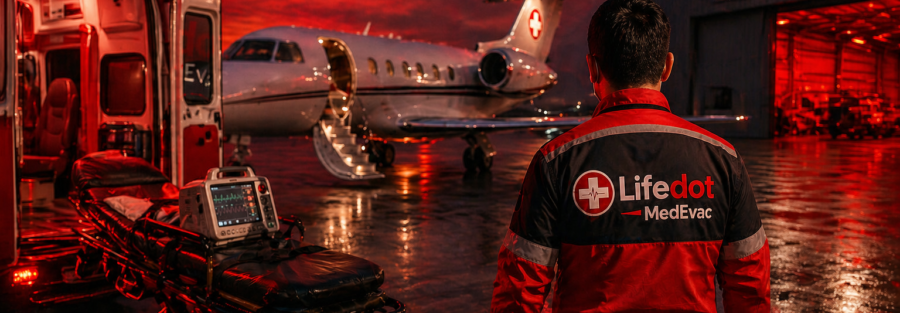
The aircraft is prepared as a functional extension of an intensive care unit. A secured stretcher system forms the centre of the cabin, supported by continuous monitoring, ventilatory support where required, and controlled infusion systems. Oxygen supply, electrical redundancy, and medical equipment integration are configured specifically for the patient. The objective is not movement, but stability.
Once airborne, the environment introduces variables that must be actively managed. Cabin pressure, although regulated, differs from ground-level conditions. For patients with respiratory or neurological concerns, these factors are accounted for throughout the flight. Medical personnel maintain continuous observation, adjusting support parameters where required, ensuring that the patient remains clinically stable at all times.
Execution during flight is defined by precision. The aircraft environment is controlled, but constrained. Every element onboard is pre-selected, every response anticipated. The medical team operates within a structured framework, ensuring that care delivery remains consistent despite the dynamic nature of flight.
Equally important is the coordination beyond the aircraft. Receiving hospitals are engaged in advance, ensuring immediate readiness upon arrival. Ground transfer, airport handling, and admission pathways are aligned before departure. The transition from air to hospital is managed as a continuous clinical process, not a separate stage.
In selected cases, where patients are stable and do not require intensive support, medically supervised commercial transfer may be considered. However, this is clinically determined. For patients requiring continuous monitoring or advanced intervention, a dedicated air ambulance environment remains essential to maintain control throughout the journey.
An air ambulance mission is defined by structure. From pre-flight preparation to in-flight management and final handover, every stage is executed under clinical oversight and operational control. There is no reliance on improvisation. Each decision is made within a defined framework, ensuring that the patient remains within a managed care pathway at all times.
This approach becomes even more critical in cross-border operations, where regulatory alignment, timing, and coordination must support both aviation and medical requirements simultaneously. The complexity lies not in distance, but in execution.