
Across Southeast Asia, the demand for cross-border medical transfer has grown steadily, driven by disparities in specialist care, hospital capacity, and the urgency of time-critical conditions. Nowhere is this more evident than in the corridor between Indonesia and Malaysia, where patients requiring advanced treatment are moved under controlled medical transport.
In such cases, the margin for error is effectively zero. Cross-border medevac is not simply a flight; it is a structured clinical and operational process where timing, precision, and medical oversight must align at every stage.
For patients in critical condition, conventional travel is not an option. The decision to initiate a medevac is made when continuous monitoring, advanced life support, or urgent access to specialised care is required. These include cardiac events, neurological emergencies, trauma cases, and complex ICU transfers. In these scenarios, the objective is not speed alone, but continuity of care under controlled conditions.
Each mission begins with clinical determination. Medical teams assess the patient’s condition, stability, and in-flight requirements, defining the level of support required throughout the transfer. This assessment drives the entire mission structure , from aircraft configuration to medical team composition and equipment integration.
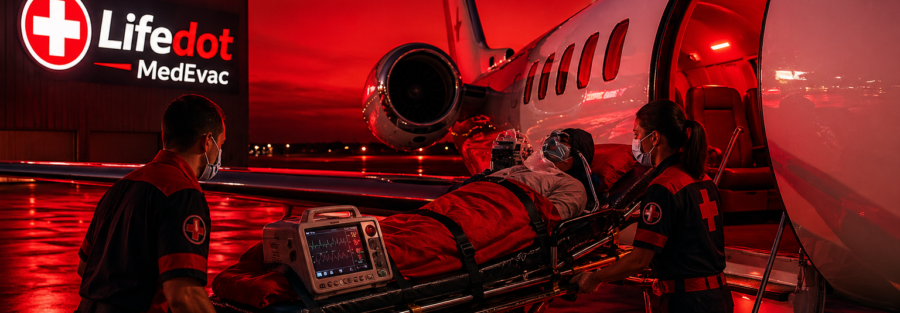
ircraft are configured specifically for each mission, with cabin layout and medical systems aligned to the patient’s clinical requirements. Ventilators, cardiac monitoring, infusion systems, and oxygen supply are integrated into a controlled environment that functions as an airborne extension of intensive care. The aircraft is not a transport platform; it is a clinical environment in motion.
Flight planning extends beyond routing and distance. Altitude, cabin pressure, and transfer duration are evaluated against patient condition to ensure physiological stability throughout the journey. These factors are managed continuously, ensuring that clinical risk is mitigated in real time.
Cross-border execution requires direct alignment with aviation authorities, airport operations, and both sending and receiving medical facilities. Timing is often compressed, particularly in urgent cases, making structured execution essential. Clearance, ground handling, and hospital readiness are synchronised before departure, ensuring that each stage proceeds without disruption.
In selected cases, medically supervised commercial transfer may be considered where patients are stable and do not require intensive care support. However, this is determined clinically. For critical cases, a dedicated air ambulance environment remains essential to maintain continuous monitoring and intervention capability.
Cost remains a practical consideration. A private air ambulance transfer between Indonesia and Kuala Lumpur typically ranges between USD 25,000 and USD 35,000, depending on medical complexity, aircraft configuration, and distance. This reflects the integration of clinical expertise, specialised equipment, aviation capability, and rapid deployment within a single mission.
What remains less visible is the discipline behind execution. Ground ambulance teams, airport operations, medical personnel, and receiving hospitals function within a single controlled pathway. The mission is not complete at landing, but at the point where the patient is safely handed over and clinical care continues without interruption.
Cross-border medevac is defined by structure. From initial assessment to final admission, each stage is executed under clinical oversight and operational control. The patient remains within a managed environment at all times, without exposure to uncontrolled variables.
Lifedot Medevac operates within this framework, executing cross-border patient transfer across Malaysia, Indonesia, and the wider ASEAN region under full clinical and operational control. Each mission is structured with clinical intent and delivered through coordinated aviation execution in real-world conditions.
As regional mobility continues to evolve, cross-border medical transfer will play an increasingly critical role. The distinction lies not in access to aircraft, but in the ability to execute with precision, consistency, and clinical responsibility, where every decision directly impacts patient outcome.